Retail Shrinkage: How to Measure It, Where the Losses Sit, and Ten Tactics That Actually Work
How to measure shrink honestly, the four root causes and their real weights, ten tactics ranked by dollar recovery per program dollar, the self-checkout question, and the culture pattern that separates operators who beat their category benchmark from operators who explain their number every quarter.
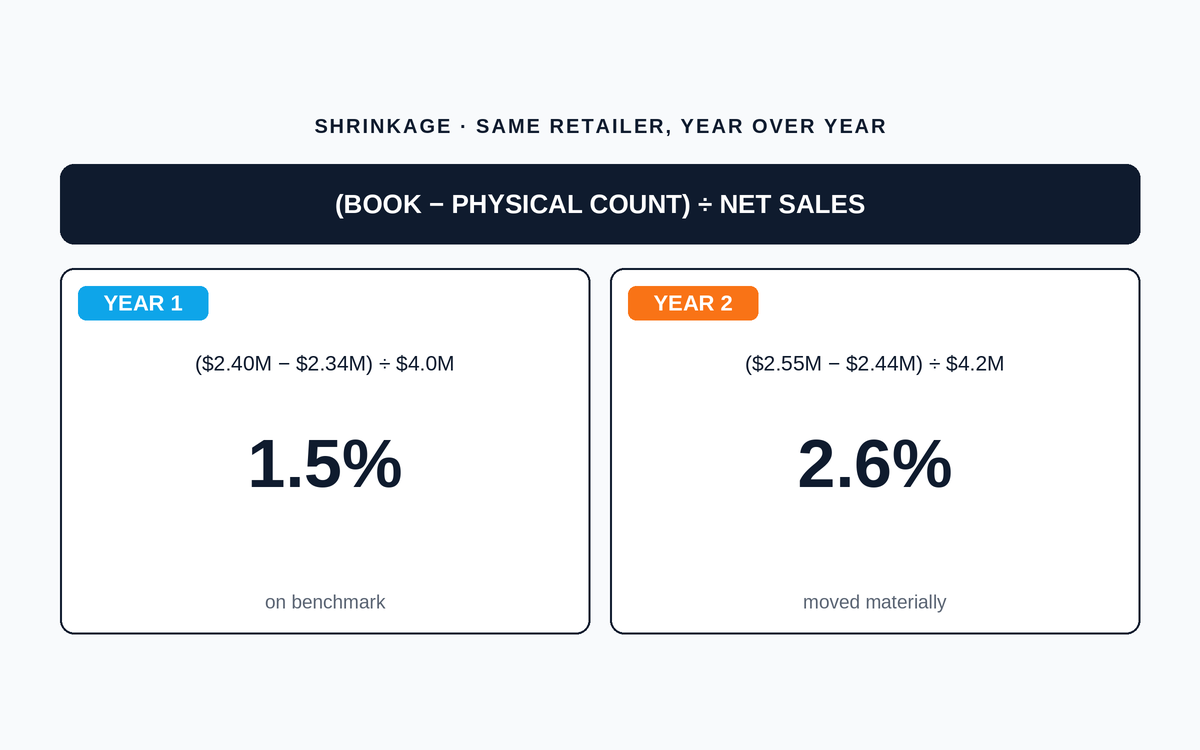
Table of contents+
NRF’s National Retail Security Survey has put annual US retail shrink above $110 billion in recent editions, running roughly 1.5 to 1.7 percent of sales industry-wide, and the trend has been climbing for several years. The headline framing in the industry press has been consistent: theft, theft and more theft. Store closures blamed on it, security spending doubled against it, national retail crime reports written about it. The framing is not wrong exactly, but it is incomplete in a way that costs most retailers real money. When the average retailer decomposes shrink honestly, external theft is commonly the largest single bucket at around a third of shrink dollars. Employee theft is another rough third. The remaining third is process and vendor issues combined: receiving errors, transfer mismatches, mis-scans at point of sale, damage that never got logged, vendor short-ships never claimed against. The exact split varies by retailer and by industry survey, but the three-way pattern is remarkably stable across published sources.
That last third is where most of the addressable dollars sit, and it is the part almost every retailer under-invests in. Cameras cost money, tags cost money, guards cost money, and every one of those investments attacks the two-thirds of shrink that is deliberate loss. The remaining third that is process is cheaper to attack, faster to fix, and rarely gets the equivalent management attention. What follows sits on the process side of the ledger for exactly that reason: how to measure shrink honestly, where the losses actually come from, ten tactics ranked by dollar recovery per program dollar, the self-checkout question specifically, and the culture pattern that separates operators who beat their category benchmark from operators who explain their number every quarter.
How to measure shrinkage
Shrinkage is the gap between the inventory the books say the retailer has and the inventory that is physically on shelves and in stockrooms. The formula converts that gap into a percentage of sales so it can be compared across categories, stores and periods.
Shrinkage % = ((Book Inventory Value − Physical Inventory Value) / Net Sales) × 100
Both inputs are at cost, not retail. Net sales excludes returns and sales tax. Measure it after a full physical count or on the rolling basis of a statistically valid cycle-count program. A worked example: a specialty retailer opens the year with book inventory at cost of $2.4M and, after a full physical count, finds actual inventory of $2.34M. Net sales for the year are $4.0M. Shrink = ($2.4M − $2.34M) / $4.0M = 1.5 percent. That is on-benchmark for general retail. Now the same retailer measures again the following year: book $2.55M, physical $2.44M, net sales $4.2M. Shrink = 2.6 percent. Something material has moved, and the tactics section is where that number gets attacked.
The trap most operators fall into is measuring only at the aggregate level. Aggregate shrink hides where the losses actually sit. Segment the number three ways: by store, by category, and by root cause. A retailer with 1.6 percent aggregate shrink might have four stores at 3.5 percent and thirty stores at 0.9 percent. The four are the entire program. Chasing the thirty is misallocated management attention. The Gross Margin Calculator makes the P&L math on shrink obvious. Every point of shrink comes straight off the gross-margin line, dollar for dollar.
Category benchmarks and the honest-comparison rule
Category context matters because shrink rates vary widely by what a retailer sells and how the assortment is protected.
Apparel and footwear: 1.2 to 1.8 percent. Standard risk, external theft dominates, self-service format on most of the assortment.
Grocery and convenience: 2.0 to 3.0 percent. Perishable spoilage adds a large process-shrink component. High-risk SKUs (alcohol, baby formula, razor blades, cosmetics) pull the average up sharply where they are stocked.
Electronics: 1.5 to 2.5 percent. High-value small items, aggressive organized retail crime targeting, and warranty/returns fraud drive the number.
Pharmacies: 1.5 to 2.0 percent. Controlled substances get intensive process controls; general merchandise runs at general-retail rates.
Luxury: below 1.0 percent. Tight controls, low unit density, one-piece-out-at-a-time selling, and CCTV coverage on every showcase reduce both external and internal theft dramatically.
Home improvement: 1.4 to 2.2 percent. Large parcel size deters casual theft but organized crime targets specific tools and copper.
Benchmarks are sanity checks, not targets. The right target is the retailer’s own trend line. A retailer running 1.4 percent shrink that trends 1.6, 1.8, 2.0 across three years has a real problem even though the number is still inside the industry benchmark. A retailer running 2.4 percent that has trended 2.9, 2.6, 2.4 is winning even though the number looks worse than a peer’s headline.
The four root causes and their real weights
Break the shrink number into its four components and the tactical priorities become obvious. Rough weights below are the pattern commonly reported across NRF, Sensormatic and consulting-firm shrink studies. Individual retailer distributions vary widely; measure your own reason-code mix before treating any published split as a target.
External theft: commonly the largest bucket, in the neighbourhood of a third of retail shrink dollars, higher in high-risk categories and lower in supervised-checkout formats. Includes shoplifting (opportunistic and professional), organized retail crime (ORC), and shipping theft on ecommerce fulfillment. ORC is the fastest-growing sub-category and typically targets the top-20 by resale value inside a store.
Internal theft: roughly another third of the total in most published surveys. Employee theft at the point of sale (sweethearting, unauthorized voids, unauthorized returns), back-door theft during receiving, and register-level manipulation. Internal theft is usually the single largest per-incident category because employees have prolonged access.
Process and paperwork errors: roughly a quarter of the total in most surveys, and the bucket most operators under-measure. Receiving discrepancies not resolved same-day, mis-scanned SKUs, price errors, unreceipted damage, transfers between stores where one side records and the other does not, and pricing changes never reflected in inventory records. Process shrink is almost pure recovery: the losses are correctable at low cost through discipline and training.
Vendor fraud and damage: the smallest of the four in most surveys, running around one in ten shrink dollars. Under-deliveries, short-counts on case-pack, damaged goods accepted without claim, and vendor invoicing errors. The recovery lever is a hard vendor-scorecard tied to OTIF and receiving-accuracy metrics.
The rough three-way split (theft, employee, process-plus-vendor) is the pattern; the exact percentages are not. A specialty electronics retailer with high-value small items skews heavily external. A grocery chain with heavy back-of-house perishable handling skews heavily process. Measure your own mix before selecting tactics. The ABC Analysis Calculator is a useful first cut for segmenting SKUs by shrink concentration once reason-code data is available.
Ten tactics ranked by dollar recovery per program dollar
Ten tactics reduce shrink, but they do not reduce it equally. Ordered by typical dollar recovery per program dollar, based on published loss-prevention benchmarks and operator surveys.
1. Weekly cycle counts on A-class SKUs
The single most under-invested tactic. Move from annual full stocktake to weekly cycle counts on A-class SKUs (top 20 percent by revenue) and monthly on B-class (next 30 percent). Cycle counts catch shrink drift in weeks rather than years and turn shrink from a lagging annual number into a leading weekly number. Cost is a few hours of store labor per week. Recovery is typically 15 to 30 percent of total shrink over the first twelve months.
2. Receiving reconciliation at the dock, not in the back office
Reconcile every shipment against the PO at the dock door, in front of the driver, and refuse discrepancies. Retailers who move receiving reconciliation from the back office an hour later to the dock in real time typically cut process shrink by 30 to 50 percent within one quarter. This is free.
3. POS exception reporting
Modern POS systems flag suspicious patterns automatically: excessive voids by cashier, refunds without receipt, no-sale drawer opens, large discount applications, transactions clustered at shift change. Weekly review of the exception dashboard by store manager plus asset protection typically recovers 8 to 15 percent of the total shrink number in the first year.
4. Category-specific hard-tag or lock-case controls
Not every SKU needs EAS tags. The top-20 by resale-value-density inside a store almost always does. Category-specific hardening (locked cases on alcohol and beauty, hard tags on high-value apparel, spider-wraps on electronics accessories) cuts external theft on those categories by 40 to 60 percent. The trade-off is shopper friction; run the math on gross-profit-per-square-foot before locking cases on marginal SKUs.
5. Front-end training on scan-not-key
Mis-keyed SKUs are a top-three source of paperwork shrink. Every SKU that is keyed rather than scanned bypasses the perpetual-inventory decrement. Train and enforce scan-only at the register. Modern POS enforces it by default; older systems need explicit policy plus supervisor oversight. Recovery is 3 to 7 percent of total shrink and is essentially free once the training is done.
6. Same-day transfer reconciliation
Store-to-store transfers are a hidden shrink source. If store A ships and store B never records receipt, both books show the inventory and physical count reveals the loss months later. Reconcile transfers same-day, escalate discrepancies within 24 hours, and shrink from transfer errors drops to near zero.
7. Scheduled CCTV review of high-risk zones
Cameras exist in most stores; systematic review of the footage does not. Focus review on receiving docks, back doors, stockrooms and cash office rather than only the sales floor. Internal theft happens away from customer view. A weekly two-hour review at the store manager level typically identifies internal-theft patterns within one quarter of routine.
8. Aged-inventory acceleration
Aged inventory shrinks at multiples of new inventory: it gets damaged, misplaced, forgotten and eventually written off as shrink rather than sold as markdown. Push markdowns through faster on aged stock. Every week an aged SKU sits unsold raises its probability of ending up in shrink rather than in a discounted sale. The DIO Calculator is the early-warning metric.
9. Confidential employee hotline plus pre-employment screening
Employee theft cases are disproportionately reported by co-workers who see it, but only when a confidential channel exists. Pair with baseline pre-employment screening on cash-handling roles. The combination cuts internal theft by 20 to 40 percent in surveyed operator studies.
10. Weekly store-level shrink review meeting
The single culture lever. Every store manager, every week, reviews the shrink number, the exception reports, the transfer discrepancies, and the cycle-count adjustments with the operations lead and asset-protection lead. What gets measured weekly gets fixed. Stores running this meeting consistently outperform their peers by 30 to 60 basis points of shrink within twelve months.
The self-checkout question specifically
Self-checkout deserves a dedicated section because it is the single largest structural shift in retail loss prevention over the last decade. Self-checkout increases shrink by 20 to 60 basis points on average versus staffed checkout, depending on assortment, attendant coverage and technology stack. On a $50M retailer running 1.6 percent shrink, a full self-checkout conversion without mitigations often pushes the number to 2.0 percent or higher, which is $200K of incremental annual loss.
The mitigations that actually work are technology-heavy: weight-check reconciliation on each scan, randomized rescans triggered by risk score, computer-vision anomaly detection, attendant intervention rules on high-risk SKUs (alcohol especially), and hard age-verification workflows. The mitigations that do not work are attendant coverage alone; attendants stationed at self-checkout without technology support catch a small fraction of loss. Some operators have retreated from unsupervised self-checkout entirely on categories above a certain resale-value density. The decision is category-specific and requires ongoing measurement, not a one-time deployment choice.
Culture: the multiplier on every tactic above
Technology and tactics matter, but the single biggest predictive variable of shrink performance across studied retailers is culture. Stores that beat category benchmarks have store managers who talk about shrink the same way they talk about sales: weekly, with named targets, with a clear post-mortem when the number moves the wrong way, and with named accountability for each root-cause bucket.
Tie a modest portion of store-manager bonus (5 to 10 percent) to shrink performance and the number moves within a single quarter. Bonus tied to shrink signals that the metric is a real KPI rather than a compliance box, and stores respond accordingly. Equally important: separate honest-mistake process shrink from intentional-loss shrink in the accountability model. Punishing process errors makes staff hide them, which is the opposite of what is needed. Reward the reporting of process shrink, punish only the concealment. Retailers that get this cultural distinction right consistently outperform retailers with more expensive technology stacks.
The takeaway
Shrinkage is a portfolio problem, not a single-cause problem. Two-thirds of it is theft, and every retailer knows to invest against theft. One-third of it is process, and most retailers under-invest against process because it is less visible in the industry press and less dramatic in the boardroom presentation. The ten tactics above attack all four root causes in ranked order of dollar recovery per program dollar. Cycle counts, receiving discipline, POS exception reporting and same-day transfer reconciliation cost almost nothing and typically recover 25 to 40 percent of the shrink number inside twelve months. Hard-tag categories, CCTV review, aged-inventory acceleration and hotline plus screening attack the deliberate-loss portion. The weekly store-level review meeting is the culture lever that makes the whole program stick. Retailers that run this playbook consistently beat their category benchmark by 30 to 80 basis points. On a $50M revenue base, that is $150K to $400K of pure gross profit added back every year, with no revenue lift required. Pair the program with the Inventory Management Tracker for adjustment-code discipline and reason-code roll-ups at the weekly review.
Frequently Asked Questions
Is 1.5 percent shrink good or bad?+
It is right at the global retail average. Best-in-class operators inside general retail run under 1.0 percent. Above 2.5 percent indicates a systemic problem in either loss prevention or back-office processes and demands immediate root-cause segmentation. The right internal target is your own trend line, not the industry benchmark.
How often should we take a physical count?+
Annual full counts are the floor. Best-in-class retailers run weekly cycle counts on A-class items, monthly on B-class, and quarterly on C-class, producing a full reconciliation cycle every 12 to 16 weeks. Annual-only counts turn shrink into a lagging indicator that cannot be fixed in the year it happens.
Should we hire external auditors for the annual count?+
Usually yes, for the full annual count. External auditors remove the internal conflict of interest and run faster than store teams. For cycle counts, internal store labor is fine and dramatically cheaper. The blended cost of external annual plus internal cycle typically runs 0.05 to 0.15 percent of net sales, well under the shrink recovery it enables.
Does self-checkout meaningfully increase shrinkage?+
Yes, typically 20 to 60 basis points versus staffed checkout, depending on assortment and mitigations. The mitigations that reduce the gap are weight checks, randomized rescans, computer-vision anomaly detection and category-restricted rules. Attendant coverage alone is not sufficient. Some operators have removed self-checkout from high-risk category zones entirely.
How do we separate paperwork shrink from theft shrink?+
Categorize every shrink adjustment by reason code at the time the adjustment is entered: mis-receive, transfer error, damage, mark-out, theft, other. Over time the distribution tells you where to invest. Most operators are surprised that 30 to 40 percent of their number is paperwork rather than theft. Reason-code discipline is the single fastest diagnostic tool available.
What is organized retail crime and how does it change the tactic mix?+
Organized retail crime (ORC) is coordinated theft of specific high-resale-value SKUs, typically for resale on secondary marketplaces. It targets top-20-by-resale-value SKUs and often involves inside knowledge of store layout and camera coverage. ORC changes the tactic mix toward hard controls (locked cases, EAS tags, receipt matching at doors) on the targeted SKU set specifically. General-shrink tactics do not deter ORC on those SKUs.
Does inventory turnover affect shrink?+
Yes, meaningfully. Higher inventory turnover reduces shrink two ways. First, less on-hand inventory means fewer aged units that end up damaged or written off. Second, faster movement makes each SKU more visible in weekly cycle counts. Retailers who improve turnover by one turn typically see 10 to 15 basis points of shrink improvement without any dedicated loss-prevention investment.
How should shrink accountability be split between store operations and asset protection?+
Store operations own the process-shrink portion (receiving discipline, transfer reconciliation, cycle counts, exception review). Asset protection owns the deliberate-loss portion (external and internal theft investigation, CCTV strategy, ORC coordination). Both report into the weekly store-level shrink meeting and share the shrink number as a joint KPI. Split ownership without a shared metric consistently underperforms shared ownership.
What is the fastest shrink lever for a retailer starting from an aggregate-only number?+
Segment the number. Break the aggregate into store-level, category-level and reason-code buckets before deciding what to fix. Almost every retailer discovers that shrink concentrates in a small number of stores, a small number of SKUs, and a small number of reason codes. Segmenting first is free, takes one working session per store manager, and prevents the classic mistake of applying blanket tactics to a concentrated problem.
Does a shrink-focused store-manager bonus really change behavior?+
Yes, more than most operators expect. Tying 5 to 10 percent of store-manager bonus to shrink performance measurably shifts weekly management attention within one to two quarters. The mechanism is simple: what leadership tracks and rewards is what store managers spend their time on. Retailers that have removed the shrink bonus tie because they thought other KPIs were more important have typically watched shrink drift 20 to 40 basis points higher within two years.
Related Calculators
Try the math from this guide with our free tools.
Gross Margin Calculator
The cleanest read on how much of every sales dollar you actually keep after paying for the goods. Gross margin drives every downstream financial decision in retail: what to price, what to promote, what to keep on the shelf. Margin percent, the markup equivalent, cost as a percent of revenue and the price-to-cost multiplier all appear together, which is what it takes to translate between the three lenses without reaching for a second tool. The COGS input behind all of it depends on how inventory is valued in the first place, and a retailer using the retail inventory method will get a different COGS figure than one costing at actual unit cost, even from identical sales and purchase data.
Open calculator
Inventory Turnover Calculator
Measure how many times a year your average inventory sells through and gets replaced. The single most consequential operational KPI in retail. It connects buying decisions, warehouse cash, markdown risk, and finance targets into one number. The turn ratio arrives converted into days and weeks of supply, together with the working capital a one-turn improvement would release. Departments that carry stock at retail value rather than cost usually track it with a retail inventory method tracking template, which produces the same average-inventory figure this calculator needs.
Open calculator
ABC Analysis Calculator
Paste a list of SKUs and their revenue and get an instant A / B / C classification. Use the output to set service levels, safety stock, and buying priority the way experienced planners do.
Open calculator
Days Inventory Outstanding Calculator
Convert your inventory position into a number finance actually reads: the average days of cash sitting on the warehouse floor. DIO is the same measurement as inventory turnover in days instead of a ratio, and it maps directly onto working capital, cash conversion cycle and reorder cadence. Four numbers come out: DIO, weeks of supply, implied turnover, and the cash a 10-day improvement would release.
Open calculator
GMROI Calculator
The single most honest cross-category profitability metric in retail. GMROI answers one question: for every dollar of inventory you funded, how many dollars of gross profit did you get back? A high gross margin on inventory that never sells produces zero return, which is why GMROI keeps margin and inventory turnover honest against each other. The output is the GMROI ratio with gross margin percent, inventory turnover, gross profit and a plain-English performance band, because the ratio on its own tells a buyer very little.
Open calculator
Related Articles
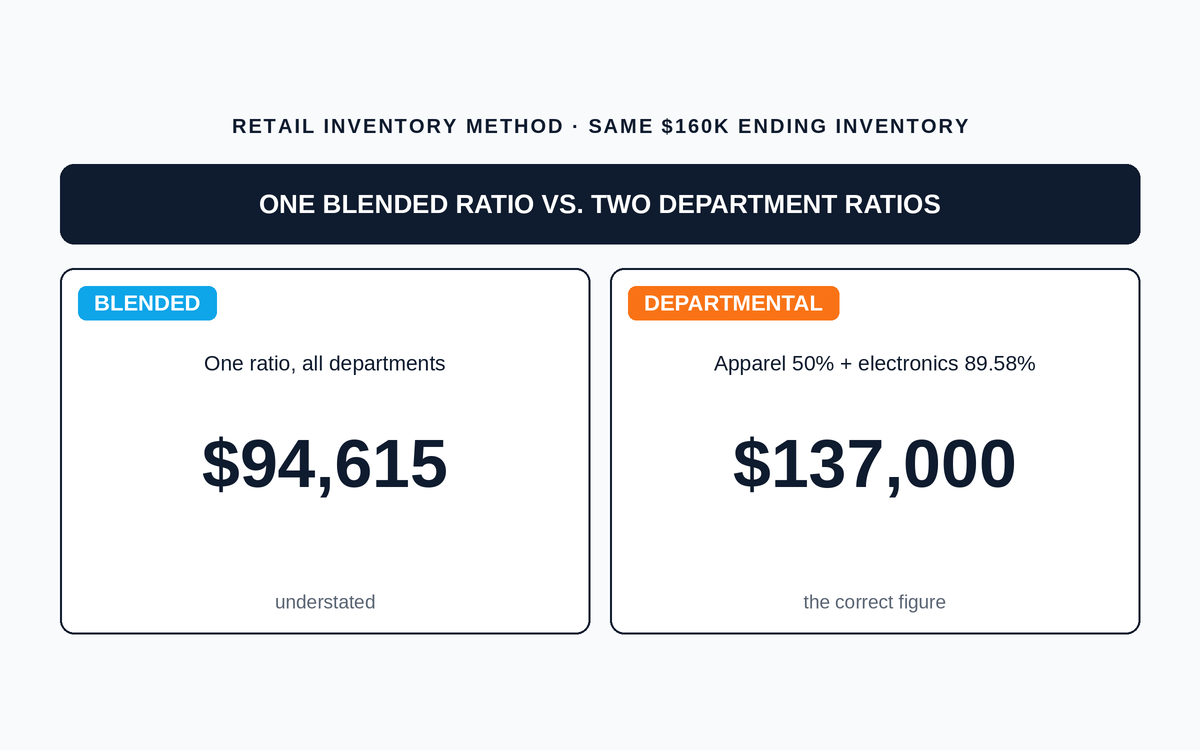
The Retail Inventory Method: Which Cost-to-Retail Ratio You Use Changes the Answer
Conventional, average cost and FIFO retail run the same inputs to different balance sheet values. What separates them, which retailers use which, and the blended-ratio mistake that costs more than the variant choice.
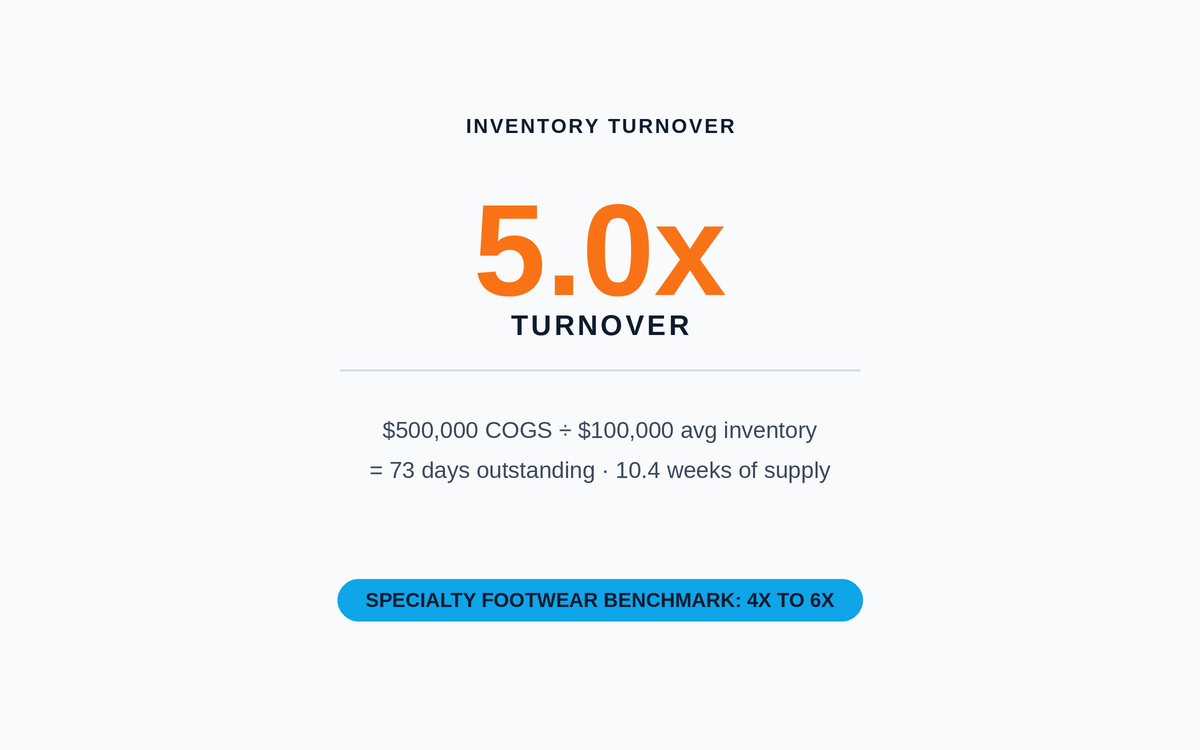
Inventory Turnover Explained: Formula, Benchmarks and How to Actually Move It
How retail operators actually work the turnover ratio. The formula, the cost-versus-sales trap, three what-if scenarios, category benchmarks, the seven levers that move turn, and the guardrails that keep higher turn from becoming lost sales.
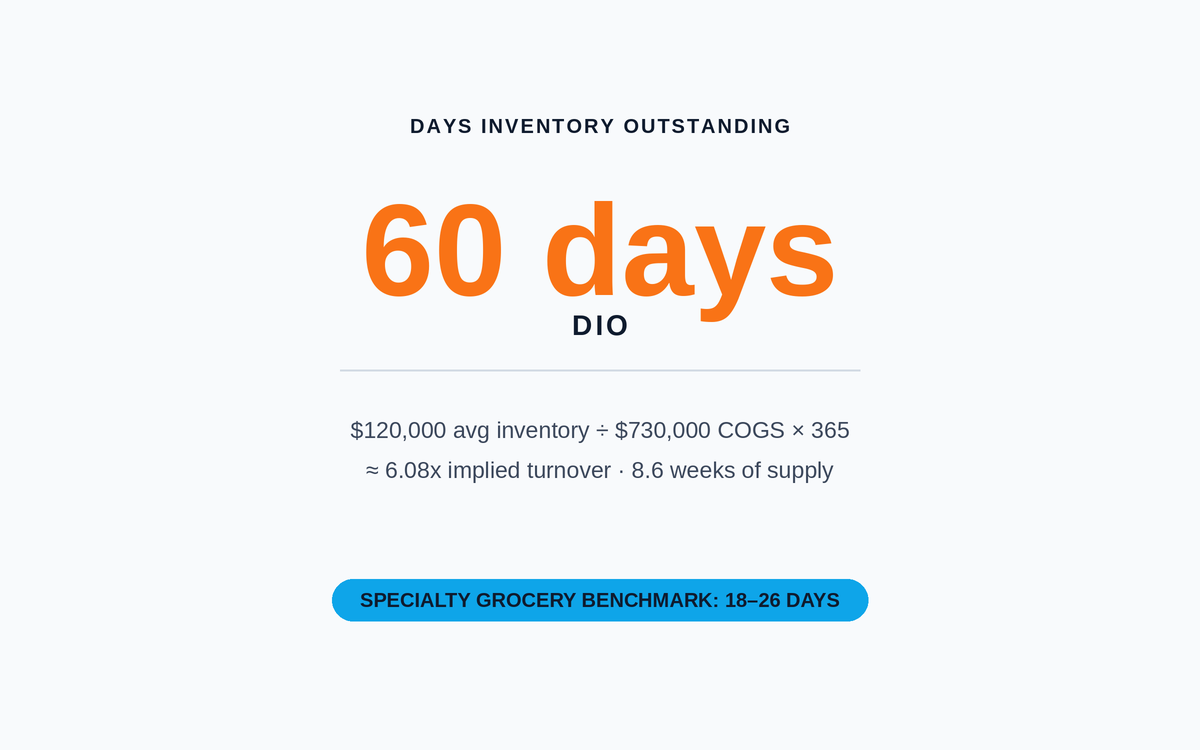
Days Inventory Outstanding (DIO) Explained: The Cash-Focused View of Inventory
How buyers and finance actually work Days Inventory Outstanding. The formula, three what-if scenarios showing exactly how much cash a 10-day DIO improvement releases, category benchmarks, cash conversion cycle context, and the levers that shrink DIO on purpose.
Explore Related Resources
Handpicked benchmarks, templates and guides to help you dig deeper.